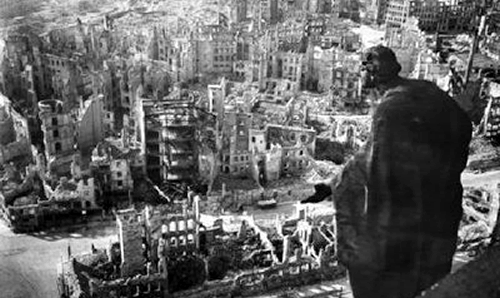
What follows below is the English translation of my speech in German which I was scheduled to deliver on February 13, 2013, around 7:00 PM in downtown Dresden. The commemoration of the Dresden February 13, 1945 victims was organized by “Aktionsbündnis gegen das Vergessen” (action committee against oblivion), NPD deputies and officials from the local state assembly in Dresden. There were 3,000 leftist antifa demonstrators. The city was under siege, cordoned off into sections by 4,000 riot policemen. The bulk of the nationalist participants, approximately 1,000, who had previously arrived at the central station, were split up and prevented from joining with our group at the original place of gathering. Toward 11:00 PM, when the event was practically over, the riot police did allow our small group of organizers and speakers to march past the barricades down to the central station. There were approximately 40 of us—mostly local NPD officials. On February 14, while still in Dresden, I provided more information as a guest on the Deanna Spingola’s RBN radio show: Hour 1, Hour 2.
"Les temps sont durs; les idées sont molles." François-Bernard Huyghe, La Soft-Idéologie
GROWING imprecision in the language of political discourse has turned virtually everyone into a democrat or, at least, an aspiring democrat. East, West, North, South, in all corners of the world, politicians and intellectuals profess the democratic ideal, as if their rhetorical homage to democracy could substitute for the frequently poor showing of their democratic institutions.1 Does liberal democracy - and this is what we take as our criterion for the "best of all democracies"-mean more political participation or less, and how does one explain that in liberal democracy electoral interests have been declining for years? Judging by voter turnout, almost everywhere in the West the functioning of liberal democracy has been accompanied by political demobilization and a retreat from political participation.2 Might it be that consciously or unconsciously, the citizens of liberal democracies realize that their ballot choices can in no substantial manner affect the way their societies are governed, or worse, that the rites of liberal democracy are an elegant smoke screen for the absence of self-government?
While a massive amount of both critical and laudatory literature on America is circulating in western Europe, only a few critical books on America and the American way of life can be found in today’s postcommunist eastern Europe. This essay is my attempt to add to that literature.
No political phenomenon can be so creative and so destructive as nationalism. Nationalism can be a metaphor for the supreme truth but also an allegory for the nostalgia of death. No exotic country, no gold, no woman can trigger such an outpouring of passion as the sacred homeland, and contrary to all Freudians more people have died defending their homelands than the honor of their women. If we assume that political power is the supreme aphrodisiac, then nationalism must be its ultimate thrill. To talk about nationalism in Anglo-Saxon countries usually evokes the specter of tribalism, violence, heavy politics, and something that runs counter to the idea of progress. For an American liberal, nationalism is traditionally associated with irrational impulses, with something incalculable that has a nasty habit of messing up a mercantile mind-set. A merchant does not like borders and national emblems; his badge of honor is his goods, and his friends are those who make the best offer on the global market. It is no coincidence that during World War II the Merchant preferred the alliance with the Commissar, despite the fact that the Commissar’s violence often eclipsed that of the Nationalist. Daniel Bell once wrote that American liberals find it difficult to grasp ethnic infatuation because the American way of thinking is “spatially and temporally suspended.” Indeed, to an insular maritime mind, it must appear absolutely idiotic to observe two people quarreling over a small creek or a stretch of land when little economic yield lies in the balance. A politician in America, unlike his rooted European counterpart, is essentially a realtor, and his attitude towards politics amounts to a real estate transaction. It is hard to deny that a person on the move, reared on Jack Kerouac or Dos Passos, is frightened by the ethnic exclusiveness that is today rocking the part of Europe from the Balkans to the Baltics. The mystique of the territorial imperative, with its unpredictable ethnic cauldron, must be a paramount insult to the ideology of the melting pot. Contrary to widespread beliefs, nationalism is not an ideology, because it lacks programmatic dimension and defies categorization. At best, nationalism can be described as a type of earthbound behavior with residues of paganism. Whereas liberalism operates in the rational singular, nationalism always prefers the irrational plural. For the liberal, the individual is the epicenter of politics; for the nationalist, the individual is only a particle in historical community. To visualize different brands of nationalism one could observe a European family camping on the rocky beaches of the French Riviera and contrast it to an American family on the sandy beaches of Santa Barbara. The former meticulously stakes out its turf, keeps its children in fold; the latter nomadically fans out the moment it comes to the beach, with each family member in search of privacy. Incidentally, the word “privacy” does not even exist in continental European languages.
Historical pessimism and the sense of the tragic are recurrent motives in European literature. From Heraclitus to Heidegger, from Sophocles to Schopenhauer, the exponents of the tragic view of life point out that the shortness of human existence can only be overcome by the heroic intensity of living. The philosophy of the tragic is incompatible with the Christian dogma of salvation or the optimism of some modern ideologies. Many modern political theologies and ideologies set out from the assumption that "the radiant future" is always somewhere around the corner, and that existential fear can best be subdued by the acceptance of a linear and progressive concept of history. It is interesting to observe that individuals and masses in our post-modernity increasingly avoid allusions to death and dying. Processions and wakes, which not long ago honored the postmortem communion between the dead and the living, are rapidly falling into oblivion. In a cold and super-rational society of today, someone's death causes embarrassment, as if death should have never occurred, and as if death could be postponed by a deliberate "pursuit of happiness." The belief that death can be outwitted through the search for the elixir of eternal youth and the "ideology of good looks", is widespread in modern TV-oriented society. This belief has become a formula for social and political conduct.
The French-Rumanian essayist, Emile Cioran, suggests that the awareness of existential futility represents the sole weapon against theological and ideological deliriums that have been rocking Europe for centuries. Born in Rumania in 1911, Cioran very early came to terms with the old European proverb that geography means destiny. From his native region which was once roamed by Scythian and Sarmatian hordes, and in which more recently, secular vampires and political Draculas are taking turns, he inherited a typically "balkanesque" talent for survival. Scores of ancient Greeks shunned this area of Europe, and when political circumstances forced them to flee, they preferred to search for a new homeland in Sicily or Italy--or today, like Cioran, in France. "Our epoch, writes Cioran, "will be marked by the romanticism of stateless persons. Already the picture of the universe is in the making in which nobody will have civic rights."1 Similar to his exiled compatriots Eugene Ionesco, Stephen Lupasco, Mircea Eliade, and many others, Cioran came to realize very early that the sense of existential futility can best by cured by the belief in a cyclical concept of history, which excludes any notion of the arrival of a new messiah or the continuation of techno-economic progress.
Language is a potent weapon for legitimizing any political system. In many instances the language in the liberal West is reminiscent of the communist language of the old Soviet Union, although liberal media and politicians use words and phrases that are less abrasive and less value loaded than words used by the old communist officials and their state-run media. In Western academe, media, and public places, a level of communication has been reached which avoids confrontational discourse and which resorts to words devoid of substantive meaning. Generally speaking, the liberal system shuns negative hyperbolas and skirts around heavy-headed qualifiers that the state-run media of the Soviet Union once used in fostering its brand of conformity and its version of political correctness. By contrast, the media in the liberal system, very much in line with its ideology of historical optimism and progress, are enamored with the overkill of morally uplifting adjectives and adverbs, often displaying words and expressions such as "free speech," "human rights," "tolerance," and "diversity." There is a wide spread assumption among modern citizens of the West that the concepts behind these flowery words must be taken as something self-evident.
JOURNAL OF SOCIAL, POLITICAL & ECONOMIC STUDIES (winter 1988, vol. 13 No 4)
by Tomislav Sunic (University of California, Santa Barbara)
The purpose of this essay is to critically examine the historical dynamics of liberalism and its impact on contemporary Western polities. This essay will argue a) that liberalism today provides a comfortable ideological "retreat" for members of the intellectual élite and decision makers tired of the theological and ideological disputes that rocked Western politics for centuries; b) that liberalism can make compromises with various brands of socialism on practically all issues except the freedom of the market place; c) that liberalism thrives by expanding the economic arena into all aspects of life and all corners of the world, thereby gradually erasing the sense of national and historical community which had formerly provided the individual with a basic sense of identity and psychological security. This essay will also question whether liberalism, despite its remarkable success in the realm of the economy, provides an adequate bulwark against non-democratic ideologies, or whether under some conditions it may actually stimulate their growth.
Oswald Spengler (1880-1936) exerted considerable influence on European conservatism before the Second World War. Although his popularity waned somewhat after the war, his analyses, in the light of the disturbing conditions in the modern polity, again seem to be gaining in popularity. Recent literature dealing with gloomy post¬modernist themes suggests that Spengler's prophecies of decadence may now be finding supporters on both sides of the political spectrum. The alienating nature of modern technology and the social and moral decay of large cities today lend new credence to Spengler's vision of the impending collapse of the West. In America and Europe an increasing number of authors perceive in the liberal permissive state a harbinger of "soft" totalitarianism that may lead decisively to social entropy and conclude in the advent of "hard" totalitarianism.1 Spengler wrote his major work The Decline of the West (Der Untergang des Abendlandes) against the background of the anticipated German victory in World War I. When the war ended disastrously for the Germans, his predictions that Germany, together with the rest of Europe, was bent for irreversible decline gained a renewed sense of urgency for scores of cultural pessimists. World War I must have deeply shaken the quasi-religious optimism of those who had earlier prophesied that technological inventions and international economic linkages would pave the way for peace and prosperity. Moreover, the war proved that technological inventions could turn out to be a perfect tool for man's alienation and, eventually, his physical an¬nihilation. Inadvertently, while attempting to interpret the cycles of world history, Spengler probably best succeeded in spreading the spirit of cultural despair to his own as well as future generations. Like Gianbattista Vico, who two centuries earlier developed his thesis about the rise and decline of cultures, Spengler tried to project a pattern of cultural growth and cultural decay in a certain scientific form: "the morphology of history"- as he himself and others dub his work - although the term "biology" seems more appropriate considering Spengler's inclination to view cultures as living organic entities, alternately afflicted with disease and plague or showing signs of vigorous life.2 Undoubtedly, the organic conception of history was, to a great extent, inspired by the popularity of scientific and pseudo¬scientific literature, which, in the early twentieth century, began to focus attention on racial and genetic paradigms in order to explain the patterns of social decay. Spengler, however, prudently avoids racial determinism in his description of decadence, although his exaltation of historical determinism often brings him close to Marx¬ - albeit in a reversed and hopelessly pessimistic direction. In contrast to many egalitarian thinkers, Spengler's elitism and organicism con¬ceived of human species as of different and opposing peoples, each experiencing its own growth and death, and each struggling for survival. "Mankind," writes Spengler, should be viewed as either a "zoological concept or an empty word." If ever this phantom of "mankind" vanishes from the circulation of historical forms, "we shall then notice an astounding affluence of genuine forms." Appar¬ently, by form ("Gestalt") Spengler means the resurrection of the classical notion of the nation-state, which, in the early twentieth century, came under fire from the advocates of the globalist and universalist polity. Spengler must be credited, however, with pointing out that the frequently-used concept "world history," in reality encompasses an impressive array of diverse and opposing cultures without common denominator; each culture displays its own forms, pursues its own passions, and grapples with its own life or death. "There are blossoming and aging cultures," writes Spengler, "peo¬ples, languages, truths, gods, and landscapes, just as there are young and old oak trees, pines, flowers, boughs and petals - but there is no aging `mankind.’"3 For Spengler, cultures seem to be growing in sublime futility, with some approaching terminal illness, and others still displaying vigorous signs of life. Before culture emerged, man was an ahistorical creature; but he becomes again ahistorical and, one might add, even hostile to history: "as soon as some civilization has developed its full and final form, thus putting a stop to the living development of culture" (2:58; 2:48). Similarly, each culture undergoes various cycles or different his¬torical "seasons": first appears the period of cultural blossoming or the spring-time of culture, followed by the period of maturation, which Spengler alternately calls summer or fall, and finally comes the period of decadence, which in Spengler's view is synonymous with "civilization." This "seasonal" flow of history is a predicament of all nations, although the historical timing of their decline varies with the virility of each nation, geographical area, or epoch. In the field of politics and statecraft, the process of decadence is very much the same. Thus, the closing years of the First World War witnessed the passing of the feudal rule of the landed aristocracy and the emergence of budding forms of parliamentary plutocracy - soon to be followed by the rise of rootless mobocracy and the "dictatorship of money" (2:633; 2:506). Undoubtedly Spengler was inspired by the works of Vilfredo Pareto and Gustave le Bon, who had earlier attempted to outline similar patterns of the rise and fall of political elites. In Pareto's and Le Bon's scheme, decadence sets in when the power elite no longer follows the established rule of social selection, and fails to identify internal and external enemies.4 Once it becomes emasculated by economic affluence and debilitated by the belief in the boundless goodness of its political opponents, the elite has already signed its own obituary. In similar words, Spengler contends that the rise of Caesarism must be viewed as a natural fulfillment of the money-dictatorship as well as its dialectical removal:
Even with their eulogy of universalism, as Serge Latouche has recently noted, Westerners have, nonetheless, secured the most com¬fortable positions for themselves. Although they have now retreated to the back stage of history, vicariously, through their humanism, they still play the role of the undisputable masters of the non-white¬-man show. "The death of the West for itself has not been the end of the West in itself," adds Latouche.1 One wonders whether such Western attitudes to universalism represent another form of racism, considering the havoc these attitudes have created in traditional Third World communities. Latouche appears correct in remarking that Eur¬opean decadence best manifests itself in its masochistic drive to deny and discard everything that it once stood for, while simultaneously sucking into its orbit of decadence other cultures as well. Yet, although suicidal in its character, the Western message contains mandatory admonishments for all non-European nations. He writes: The mission of the West is not to exploit the Third World, nor to christianize the pagans, nor to dominate by white presence; it is to liberate men (and even more so women) from oppression and misery. In order to counter this self-hatred of the anti-imperialist vision, which concludes in red totalitarianism, one is now compelled to dry the tears of white man, and thereby ensure the success of this westernization of the world. (41) The decadent West exhibits, as Spengler hints, a travestied culture living on its own past in a society of different nations that, having lost their historical consciousness, feel an urge to become blended into a promiscuous "global polity." One wonders what would he say today about the massive immigration of non-Europeans to Europe? This immigration has not improved understanding among races, but has caused more racial and ethnic strife that, very likely, signals a series of new conflicts in the future. But Spengler does not deplore the "devaluation of all values" nor the passing of cultures. In fact, to him decadence is a natural process of senility which concludes in civilization, because civilization is decadence. Spengler makes a typically German distinction between culture and civilization, two terms which are, unfortunately, used synonymously in English. For Spengler civilization is a product of intellect, of completely rationalized intellect; civilization means uproot¬edness and, as such, it develops its ultimate form in the modern megapolis which, at the end of its journey, "doomed, moves to its final self-destruction" (2:127; 2:107). The force of the people has been overshadowed by massification; creativity has given way to "kitsch" art; geniality has been subordinated to the terror of reason. He writes: