Les Anciens, c’est à dire nos ancêtres gréco-germano-gallo-slavo-illyro-romains, étaient fort conscients des causes héréditaires de la décadence quoiqu’ils attribuassent à cette notion des noms fort variés. La notion de décadence, ainsi que sa réalité existent depuis toujours alors que sa dénomination actuelle ne s’implante solidement dans la langue française qu’au XVIIIème siècle, dans les écrits de Montesquieu.1 Plus tard, vers la fin du XIXème siècle, les poètes dits « décadents », en France, étaient même bien vus et bien lus dans les milieux littéraires traditionalistes, ceux que l’on désigne aujourd’hui, de façon commode, comme les milieux « d’extrême droite ». Par la suite, ces poètes et écrivains décadents du XIXème siècle nous ont beaucoup marqué, malgré leur mœurs souvent débridées, métissées, alcoolisées et narcotisées, c’est-à-dire malgré leur train de vie décadent.2
Interpretations of any text, on any social subject and at any time, including the interpretation of the verses by the Roman poet Juvenal, are also the mirror image of the dominant political ideas — the dominant zeitgeist. But who will control the interpreter if many Western dissident thinkers today are forced to follow the pedagogical ukases set up by politicians after the end of World War II? In this respect one could cite Juvenal and his famous verse in the Sixth satire: “Quis custodet ipsos custodes.” Who will guard the guardians?, or better yet who will control the architects of today’s newspeak which is raging in the Western universities and in the mass media?
Among Europeans, since antiquity, envy and jealousy have been main driving forces in the political process, resulting in a treasure trove of different literary genres. All European languages make a fine distinction between envy and jealousy, although both notions often overlap. The Germans have an additional nuanced word for this character aberration, i.e. “Schadenfreude,” a compound noun literally meaning when someone rejoices over someone else’s bad luck.
Physical blindness and the verdict of ignorance, meted out to envious politicians in Dante’s epic poem, can often be bliss. Eyelessness can have advantages, as demonstrated by the blind, poor, uneducated, self-effacing, albeit very intelligent seer, Tiresias, who is brought to the court of King Oedipus, only to announce to him his eyeless future of blind destiny (vv 364-377).
Days and months of atonement keep accumulating on the European wall calendar. The days of atonement however, other than commemorating the dead, often function as a tool in boosting political legitimacy of a nation – often at the expense of another nearby nation struggling for its identity.
A clarification of terms and concepts is in order when dealing with trendy words in the social sciences. Although the idea of identity is an ancient theme, the word ‘identity’ over the last few decades has been subject to a flurry of subjective interpretations, resulting often in contradictory definitions. One hundred years ago, the word ‘identity’ was used in forensic medicine and in police files, but seldom in the sense of national, religious or racial identities. Therefore, today’s usage of the word ‘identity’ is not always appropriate given that this word can easily elicit contradictory meanings depending on who is using it and in what political environment. Thus, for instance, a citizen from the Federal Republic of Germany can carry multiple identities that may complement each other, but they may also exclude each other. He can describe himself as a “good European,” although he may be of North African or Turkish stock, and may in addition sport several other vocational identities that have nothing in common with his racial, religious or national heritage.
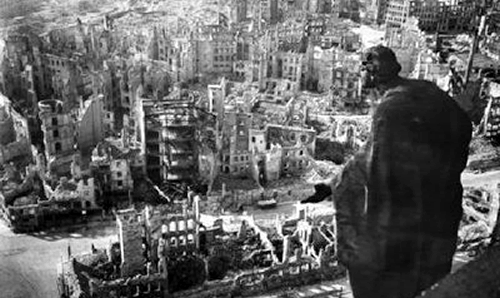
What follows below is the English translation of my speech in German which I was scheduled to deliver on February 13, 2013, around 7:00 PM in downtown Dresden. The commemoration of the Dresden February 13, 1945 victims was organized by “Aktionsbündnis gegen das Vergessen” (action committee against oblivion), NPD deputies and officials from the local state assembly in Dresden. There were 3,000 leftist antifa demonstrators. The city was under siege, cordoned off into sections by 4,000 riot policemen. The bulk of the nationalist participants, approximately 1,000, who had previously arrived at the central station, were split up and prevented from joining with our group at the original place of gathering. Toward 11:00 PM, when the event was practically over, the riot police did allow our small group of organizers and speakers to march past the barricades down to the central station. There were approximately 40 of us—mostly local NPD officials. On February 14, while still in Dresden, I provided more information as a guest on the Deanna Spingola’s RBN radio show: Hour 1, Hour 2.
Kein anderes politisches Phänomen vermag so kreativ und so destruktiv zu wirken wie der Nationalismus. Nationalismus kann Metapher sein für letzte Wahrheit und zugleich Allegorie für die Nostalgie des Todes. Kein exotisches Land, kein Gold, keine Frau kann solche Gefühlsausbrüche hervorrufen wie das geheiligte Vaterland, und, alle Freudianer mögen verzeihen, mehr Menschen sind für die Verteidigung ihres Vaterlands gestorben als für die Verteidigung der Ehre ihrer Frauen. Wenn wir davon ausgehen, dass politische Macht das stärkste Aphrodisiakum darstellt, so muss der Nationalismus die äußerste Erfüllung sein. Spricht man in angelsächsischen Ländern über Nationalismus, so wird dieser gewöhnlich reflektiert als Ausdruck uralter Stammesriten, als Gewalt und böse Politik, als etwas, das dem Fortschrittsgedanken zuwider läuft. Für einen amerikanischen Liberalen ist Nationalismus traditionell mit irrationalen Impulsen verknüpft, mit etwas Unkalkulierbarem, das zudem den hässlichen Zug aufweist, kaufmännische Denkungsart zu verderben. Ein Kaufmann liebt weder Grenzen noch nationale Symbole, seine Ehre sind seine Handelsgüter, seine Freunde sind die, die auf dem weltweiten Markt die besten Offerten unterbreiten. Es ist kein Zufall, dass der Kaufmann während des Zweiten Weltkriegs die Allianz mit dem Kommissar vorzog, ungeachtet dessen, dass die Grausamkeit des Kommissars oftmals die des Nationalisten in den Schatten stellte. Daniel Bell hat einmal geschrieben, amerikanische Liberale fänden es schwierig, ethnische Verblendung überhaupt zu verstehen, da die amerikanische Denkungsweise „räumlich und zeitlich nicht festgelegt" sei. In der Tat muss es einem insularen Geist absolut närrisch erscheinen, wenn er zwei Völker beobachtet, die sich um einen kleinen Bach oder einen winzigen Streifen Land streiten, wenn zudem kaum ökonomischer Vorteil im Spiel ist. Der Politiker in Amerika ist, im Gegensatz zu seinen europäischen Kollegen, für gewöhnlich zunächst Grundstücksmakler, und seine Haltung zur Politik gleicht der zu einer Transaktion.
C'est le 16 avril, après le oui triomphal (83,8 %) des Hongrois à l'Union, qu'a été "couronnée" à Athènes l'Europe de 25, sanctionnée par un traité de 5 000 pages qu'ont signé pour la France Jean-Pierre Raffarin et Dominique de Villepin avec la bénédiction de Kofi Annan, secrétaire général de l’ONU, sous l'égide de laquelle s'inscrit donc la "Nouvelle Europe". Un parrainage assez inquiétant, notamment en ce qui concerne la liberté d'expression. La police de la pensée est difficile à repérer car elle se cache souvent sous les concepts rassurants de "démocratie" et "droits de l'homme." Si les Quinze exhibent volontiers les beautés de leurs paragraphes constitutionnels, ils admettent rarement les ambiguïtés de leur Code pénal. Et c'est dans une grande discrétion que l'an dernier, la Commission européenne avait tenu a Bruxelles, et à Strasbourg des réunions d'une importance historique sur l’avenir de la libre parole.
Tomislav Sunic, essayiste croate et traducteur, ayant longuement séjourné aux Etats-Unis où il a enseigné la science politique, vit actuellement dans son pays d'origine. Il a récemment publié un ouvrage intitulé Homo Americanus : Child of the Postmodern Age (BookSurge, Charleston 2007, 15.99 $), avec une préface de l'historien Kevin MacDonald. L'auteur a accepté de s'expliquer sur le parallèle suggéré par son titre, de prime abord audacieux, avec l'homo sovieticus de Zinoviev.